



Implant supported dentures are full or partial dentures anchored to titanium implants placed in your jawbone, instead of resting loosely on your gums. They stay secure while you eat, talk, and smile. Yardley Dental Arts evaluates candidacy, plans implant placement, and fits custom implant dentures for patients across Bucks County.
Key Takeaways
Your dentures shift when you laugh at dinner. They click when you talk. And no amount of adhesive seems to fix it for good.
That’s a familiar scene across Bucks County. Loose dentures are one of the most common complaints we hear from patients in Yardley, Newtown, and Langhorne. Standard dentures rest on the gum ridge alone, so they shift, rub, and depend on adhesive to stay put.
Implant supported dentures fix that problem at the source. Our team at Yardley Dental Arts sees this pattern often: patients who’ve worn dentures for years, tired of the daily guesswork, ready for something that actually stays in place.
Here’s what we’ll cover: how implant supported dentures work, which types exist, and how the process runs from consultation to final fit. You’ll also see what to expect from a consultation with Dr. Smolen at our Yardley, PA office.
Let’s start with why the denture keeps moving in the first place.
Implant supported dentures, also called implant retained dentures or overdentures, are removable or fixed dental prosthetics secured to two or more dental implants instead of resting on the gum ridge alone. The implants act as artificial tooth roots, giving the denture a stable anchor point. Across Bucks County, patients choose them to reduce shifting, cut down on adhesive, and help preserve jawbone density where teeth once stood.
Picture a denture that fit fine a year ago and now clicks every time you talk. Why? Traditional dentures rest on gum tissue with no root structure underneath, and the jawbone naturally shrinks once teeth are gone. Standard adhesives can’t fix a foundation that keeps changing shape.
Newtown patients bring us this exact complaint often: a denture that used to fit now feels loose no matter how much paste they use. That’s not a sign you’re doing something wrong. It’s what happens when there’s nothing anchoring the denture to bone, which is exactly why replacing missing teeth sooner tends to give you more options later.
So what actually holds an implant supported denture in place?
Think of implants as the roots your natural teeth used to have. In a traditional denture, there are no roots left, just gum tissue and bone doing their best to hold things in place.
With implant supported dentures, Dr. Smolen places small titanium posts into the jawbone, similar to the process used for mini dental implants in patients with lower bone density. Over a period of weeks, the bone fuses to these posts through a process called osseointegration. Once that bond is solid, your denture attaches to the implants using connectors, either snapping into place or being permanently secured.
Here’s a question worth asking yourself: how much can a loose denture affect your day-to-day confidence and comfort? Patients across Langhorne and Yardley describe avoiding certain foods, laughing less at parties, or worrying mid-sentence. Implants change that equation because the denture simply doesn’t move.
Most full-arch cases use between two and four implants, though your exact number depends on your jawbone’s density and the type of denture you choose.
Want a straight answer on whether you’re a candidate? Book a consultation with Dr. Smolen and our team, and we’ll walk you through your options based on your own jawbone and denture history. |
So how do the two options actually stack up? Morrisville patients ask us this constantly, especially those who’ve worn traditional dentures for years and are tired of the maintenance routine. If you’ve already compared dental implants vs dentures in general, this next table narrows things down further.
| Factor | Traditional Dentures | Implant Supported Dentures |
| Stability | Rests on gums, can shift when eating or speaking | Anchored to implants, stays in place |
| Bone Health | Bone loss continues over time | Implants help slow bone loss |
| Adhesive Needed | Usually yes | Rarely, depending on the design |
| Chewing Force | Reduced compared to natural teeth | Closer to natural biting force |
| Speech | May affect clarity for some patients | Typically more natural |
Neither option is automatically better for every patient. It comes down to bone health, priorities, and how much stability matters to your daily life. That’s exactly what a consultation helps sort out.
Implant dentures offer more stability, better chewing function, and help slow bone loss compared to traditional dentures. Regular dentures remain a reasonable option for some patients based on bone health or personal preference. Neither is universally better. It depends on your specific situation and what Dr. Smolen finds during your exam.
Langhorne patients often assume implants are off the table because they’ve worn dentures for years. That’s not always true, but it’s a fair question to ask.
Good candidates typically have:
Here’s the thing about bone loss: it doesn’t stop just because you’re already wearing dentures. The longer teeth have been missing, the more the jawbone tends to shrink. That’s why we usually recommend an evaluation sooner rather than later. Waiting can sometimes mean needing a bone graft where none would’ve been needed before, something we cover in more depth in our guide on modern solutions for missing teeth.
If you’re unsure whether you qualify, a simple exam and imaging session at our Yardley office tells us almost everything we need to know.
Not sure where you stand on bone density? Bring your denture history to a consultation and Dr. Smolen will walk you through exactly what your jawbone allows for. |
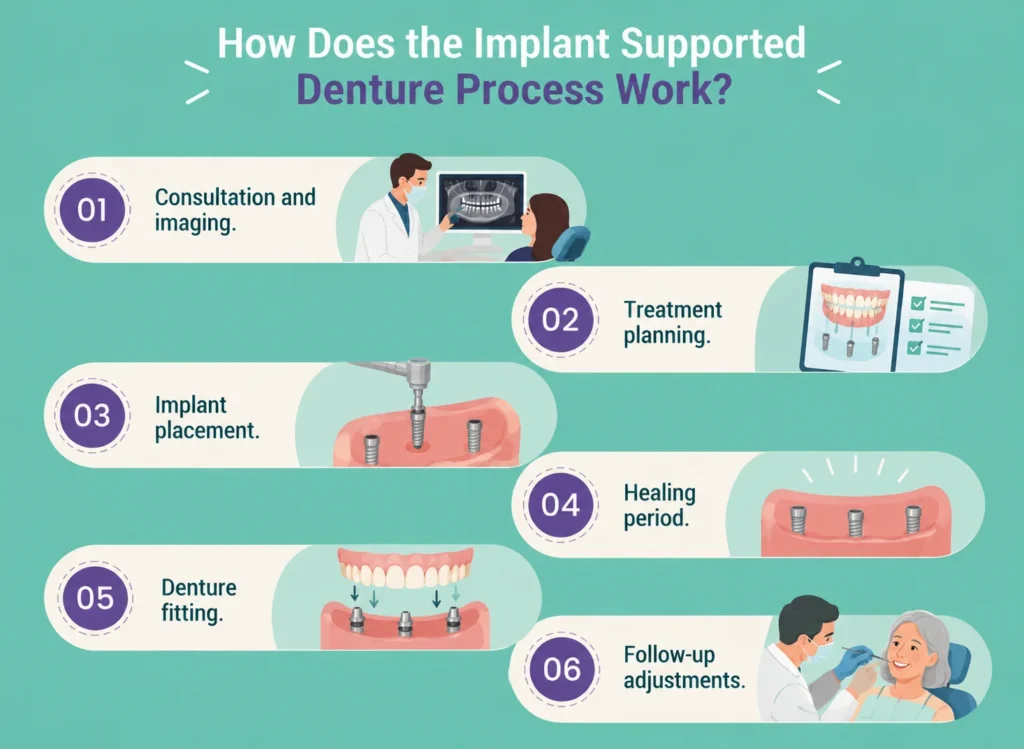
Bucks County patients ask us the same thing almost every time: how long is this actually going to take? Fair question, and the honest answer is that it depends on your starting point.
This process builds on the same fundamentals covered in our overview of implant dentistry essentials, just applied specifically to a full denture case.
Most full-arch implant supported dentures use two to four implants, though some fixed designs use more for added stability. Your exact number depends on jawbone density, whether you’re replacing an upper or lower arch, and the type of denture connection you choose. Dr. Smolen determines this during your consultation and imaging appointment.
Bucks County patients usually fall into one of two camps once they understand implants are an option: some want the denture removable for cleaning, others want it permanently fixed. Both are valid, and both rely on the same implant foundation.
It depends on the design. Snap-in implant dentures are meant to be removed by the patient for cleaning and overnight rest. Fixed implant dentures are bonded to the implants and are only removed by a dental professional during checkups or maintenance visits. Dr. Smolen recommends the design that fits your lifestyle and oral hygiene habits.
Here’s something patients don’t always expect: implant supported dentures still need daily attention, just a different kind than traditional dentures.
Lower Makefield patients who’ve made the switch often tell us the daily routine feels easier than what they were doing with adhesive-based dentures. Fewer messy pastes, less second-guessing whether the fit will hold through dinner. Good implant hygiene also ties directly into overall gum health, since the tissue around your implants still needs the same care as natural gums.
Implants themselves can last many years, often decades, when properly cared for and monitored through regular checkups. The denture attached to the implants may need replacement or relining over time due to normal wear. Dr. Smolen tracks both the implants and the denture at routine visits to catch issues early.
Related Content: Still deciding between denture types before committing to implants? Our guide to choosing the right pair of dentures walks through the basics first. |
We get it. Choosing where to have implant work done is a big decision, and you want to know who’s actually doing the planning behind the scenes.
Dr. Alan Smolen has practiced dentistry in the Yardley area for more than 30 years and serves as an associate clinical professor at NYU College of Dentistry, where he teaches advanced restorative and implant cases to other dentists. He trained at the Pankey Institute for advanced dental education and holds memberships with the American Dental Association, the Pennsylvania Dental Association, and the American Academy of Cosmetic Dentistry.
None of that matters if the experience in the chair isn’t good, though. That’s why our practice has built a 4.9 out of 5 rating from patients across more than 400 Google reviews, many of whom mention feeling heard rather than rushed through treatment planning. You can see our full list of services to get a sense of how implant care fits into everything else we handle in-house.
Ready to stop guessing and start planning? Bring your questions, your denture history, and your concerns. We’ll give you a clear, honest assessment of whether implant supported dentures make sense for you. |
Loose dentures aren’t something you have to accept as permanent. Implant supported dentures give patients across Yardley, Newtown, and Bucks County a way to eat, speak, and smile without worrying about slipping or clicking.
The decision comes down to your bone health, your priorities, and an honest conversation with a dentist who’s done this kind of planning before. That’s exactly what we offer at Yardley Dental Arts.
Why does that matter? Because a denture that stays put changes how you eat, talk, and show up in everyday moments, whether that’s a family dinner in Newtown or a birthday photo you actually want to smile in.
Here’s your next step. Think about what your current denture keeps you from doing, then let Dr. Smolen take a look.
Yardley Dental Arts has served Bucks County patients for more than 30 years, with Dr. Smolen holding faculty status at NYU College of Dentistry alongside a 4.9 out of 5 rating across 429 Google reviews.
You don’t need every answer today. You only need to start. Call (215) 504-2400 or reach out through our website.
Yes. Our team evaluates candidacy, plans implant placement, and fits custom implant supported dentures for patients across Yardley, Newtown, Langhorne, and the surrounding Bucks County area. We walk you through every stage, from imaging to final fitting.
Implant supported dentures involve implant placement and a healing process, which can differ from traditional dentures. The exact approach depends on how many implants you need and your specific treatment plan. We’ll discuss your options and what to expect during your consultation.
Timelines vary based on healing and bone health, but the process generally spans several months from consultation through final fitting. This includes imaging, implant placement, a healing period for osseointegration, and the denture fitting itself. Dr. Smolen gives you a personalized timeline after your initial exam.
Implant dentures offer more stability, better chewing function, and help slow bone loss compared to traditional dentures. Regular dentures remain a reasonable option for some patients based on oral health, bone health, or personal preference Neither is universally better. It depends on your specific situation and goals.
Traditional dentures rest on your gum ridge with no anchor point, which is why they can shift, click, or require adhesive. Implants replace the root structure your natural teeth used to provide, giving the denture something solid to attach to. That anchor is what keeps the denture from moving during eating or speaking.
Yes. Dr. Smolen has practiced in the Yardley area for more than 30 years and regularly treats patients traveling from Newtown, Langhorne, Morrisville, and throughout Bucks County for implant and denture care.
Candidacy depends on your jawbone density, gum health, and overall medical history. The only reliable way to know is through an exam and imaging appointment, where we assess your bone structure and discuss your denture history. Even patients who’ve worn dentures for years may still qualify, sometimes with a bone graft first.
You can call our office directly at (215) 504-2400 or reach out through our website contact form. We’ll schedule an initial exam and imaging appointment to evaluate your candidacy and answer any questions about the process.
"My mission is to always provide extraordinary dental care in a compassionate setting. At Yardley Dental Arts, quality is key! We are NOT a high volume, high turnover office. We are patient centric office. Our practice model allows for concierge service and exclusive one on one time with the doctor and the hygienists. We pride ourselves on using premier materials, labs and the latest in dental technology including our GREEN CT 3D SCANNER, delivering high quality images at a fraction of the radiation as compared to the standard. This allows for fully customized treatment plans focusing on your specific needs and comfort level.
It’s a pleasure to serve you and your family for your comprehensive dental needs. Every one of us is passionate about what we do, and it shows! I look forward to meeting you."
